Dyck paths is Catalan
Tags: #theorem
Statement
The number of Dyck path of length
Below are three proofs:
- generating functions
- reflection method - a bit more combinatorial in nature, we are finding the number of lattice paths and subtracting away the ones that aren't Dyck paths
- cyclic shifts - we count all the paths and then split into cosets
Proof 1 (Generating functions)
First, we show the following relation:
Let's think about when the Dyck path first touches
We can break this path into two parts left and right:
- We see that what happens on the right of
is just another Dyck path of length . Thus, the number of such paths is given by - On the left however, this path must never touch the
-axis (as we assumed that the path first touches the -axis at the point ). This also means that we know what the endpoints (as in the first and last move) of this path looks like: the first move is up and the last move (to reach the -axis at ) is down. If we move the -axis up to , then we note that the portion above this is a Dyck path of length (taking away the two end segments). Thus, there are number of paths here.
Summing over all possible
Now consider the generating function
fun fact: this power series converges for
We now claim that
- This is evidently true for
as and is divisible by . - Note that two identities
for (and for , it is 0)
- Applying these two, we have
which we know by the above relation is equal again to.
Now, we can use the quadratic equation to obtain the two solutions
To figure out which solution it is, note that
(by L'Hopital's) <- so it's this one
Then (applying the generalized binomial theorem), we have
Proof 2 (reflection method)
We first notice that there are
Suppose we have a non-Dyck path
- from
to , it is the same as - from
to , we reflect the directions
Notice that this path ends atsince it has up steps and down steps.
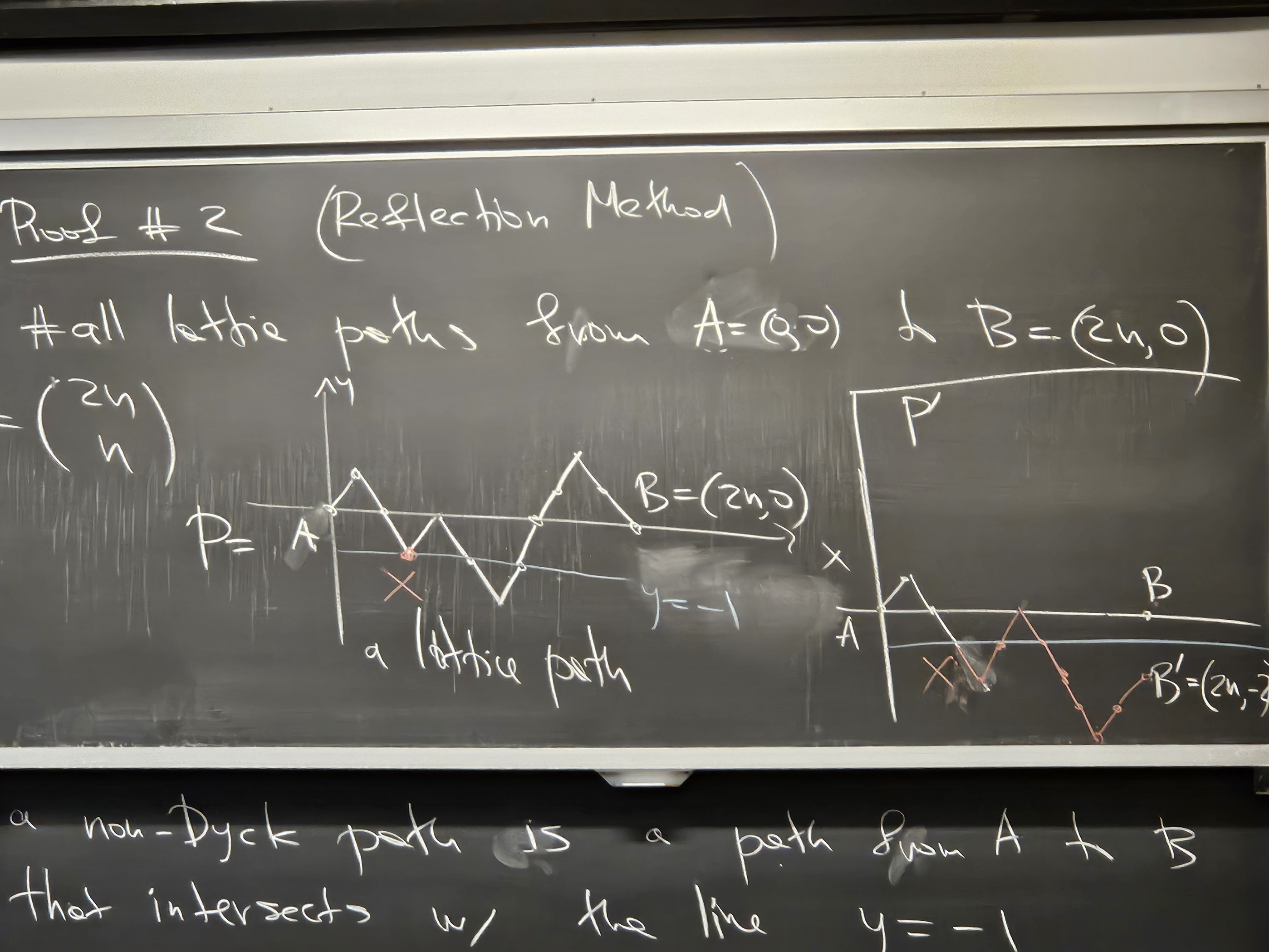
Now, we claim that this construction
Now there are
as desired.
Proof 3 (cyclic shifts)
Motivation
First, we observe that
and we can interpret
We can cyclically shift the path:
- "+ - - + - "
- "- - + - +"
- "- + - + -"
- "+ - + - -"
- "- + - - +"
This gives us
Proof
We finish the proof if we can prove these two facts:
- All paths obtained from cyclically shifting are different
- Exactly one of them is a Dyck- path
Since we can create an equivalence class of paths that can be obtained by cyclic shifting, which partition the space of all paths into classes of size
Mark the first (global) minimum as
For
If