hook length formula

Tags: #theorem

Statement

Let fλ be the number of standard Young tableaux of shape λ (a partition). Let h(b) for bλ be the hook length. Then,

fλ=n!bλh(b)

As notation, let H(λ)=bλh(b).

This was proven by Frame-Robinson-Thrall in 1953.

Proof

We give the "Hook walk" proof by Greene-Nijenhuis-Wilf (1979). The intuition is as follows:

There is a recurrence relationship that fλ satisfies:

fλ=c cornerfλc

Where a corner box is defined to be the boxes with hook length 1 (ie. there are no boxes below or to the right of it). We note that the largest number of the tableaux must be in a corner box. If the largest number is in some corner box c, then we can fill in the rest of the diagram (λc) in fλc ways. Then, we sum over all corner boxes.

It then suffices to show that the RHS also satisfies the recurrence relation. In other words, we need to show

n!H(λ)=c corner(n1)!H(λc)

which is equivalent to showing that

c corner1nH(λ)H(λc)=1

We shall do so by viewing this as a probability measure. In particular, we want to show that 1nH(λ)H(λc) is the probability of something depending on c.

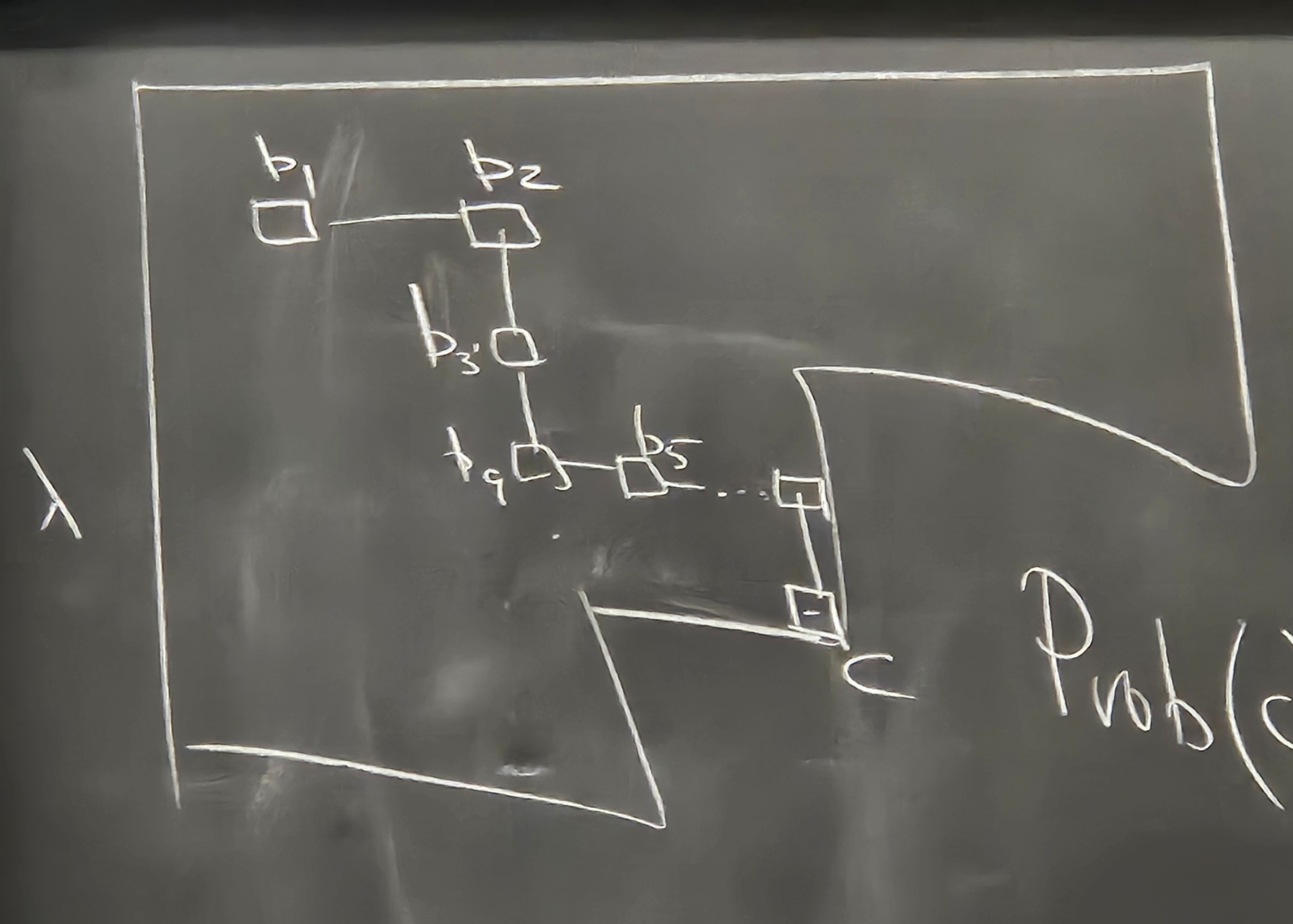
Consider the random process (which we shall call a Hook walk):

  1. Randomly select a box b1λ (so each box has a probability of 1n of being selected)
  2. Repeat for i1: starting from bi, pick bi+1 in the hook of bi (that is not bi)
  3. Note that the above process terminates once we reach a corner box c. Output this c.
    Example:
    20260211_132617.jpg

We want to ask about the probability that this hook walk ends at some corner c, which we shall denote as P(c). We note that this is equal to:

P(c)=b1b2br=c1n1h(b1)11h(b2)11h(br1)1

where we take the sum over all hook walks that end at c. So, it suffices to show that

1nH(λ)H(λc)=b1b2br=c1n1h(b1)11h(b2)11h(br1)1

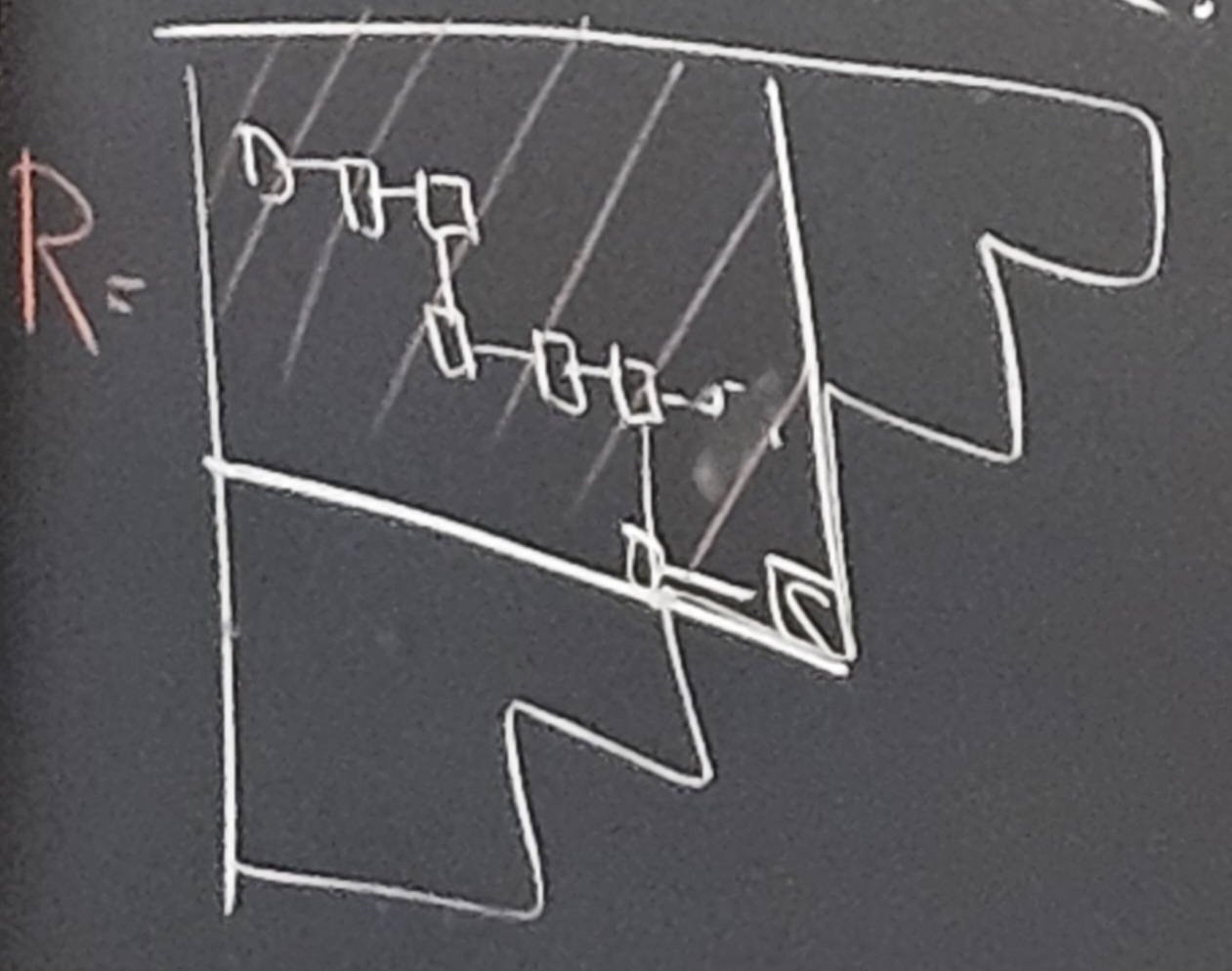
First, we note that any hook walk that ends at c must lie in the rectangle R with vertices cut out by (1,1) and c:
20260211_133307.jpg

For any box aR, we can find b,d such that we have a rectangle with the boxes abcd.

Furthermore, let the cohook be the boxes that are above and to the left of a box. Note that b,d lie in the cohook of c.
20260211_133307 (1).jpg

We further note that

h(a)+h(c)=h(b)+h(d)h(a)1=h(b)1+h(d)1

The second line obtained by subtracting one from both sides and noticing that h(c)=1. This means in particular that the hook length of any box within the rectangle is determined by the hook length on the sides.

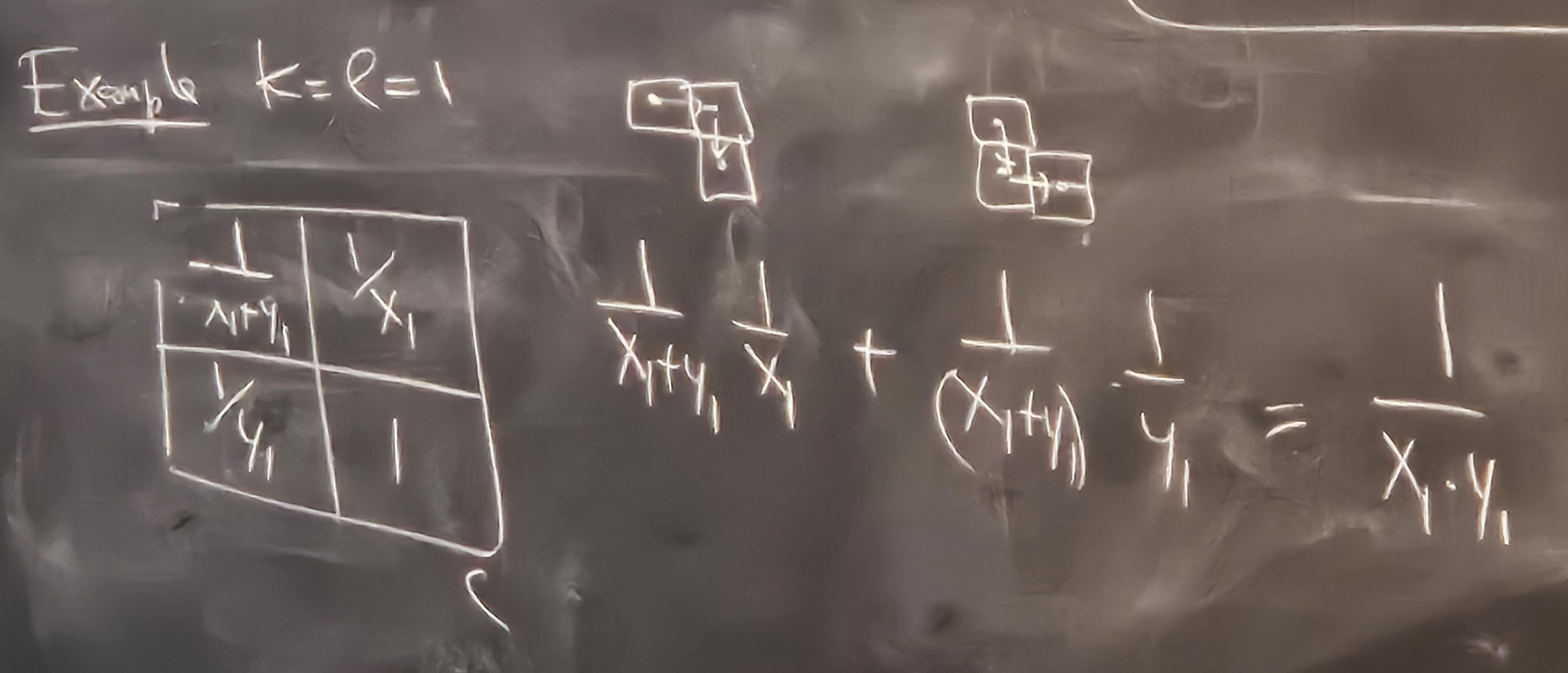
Let R have side lengths (k+1)×(l+1) and for each box b in this rectangle, associate it with the weight h(b)1. We shall say that the weight of a hook walk is the product of all the weights of the boxes that are in the hook walk. Furthermore, label the boxes in the cohook of c with x1,,xk (with xi being the box in position (i,l+1), the vertical line) and y1,,yl (with yi being in the box (k+1,i), the horizontal line).
This in particular means that the weight of any box is 1xi+yj if they are in the ith row and the jth column.

Here is a simple example of the weight of a path:
20260211_134254.jpg

Lemma: Define a lattice path to be a Hook walk that is connected. We claim that

p lattice path in Rwt(P)=1x1xky1yl

We proof via induction on k+l (in particular, note that the base case will be the n×1 and the 1×n strip, which is not too hard). For the inductive case, let a be the box directly to the right of a=(1,1), and a be the box directly below a. We have the recurrence:

p:acwt(P)=1x1+y1(p:acwt(p)+p:acwt(p))=1x1+y1(1x1xky2yl+1x2xky1yl)=1x1xky1yl

Now we can apply this lemma to prove the same formula for a general hook walk:
For every box, we mark down the rows and columns that it occupies. This creates a subgrid, and within this subgrid, we have a lattice path. We may then apply the lemma to get

p hook walk in Rwt(P)=I[k],J[l]1iIxijJyj=i=1k(1+1xi)j=1l(1+1yl)

So in general, we have the formula for the probability that a hook walk will end at c:

P(c)=1ni=1k(1+1xi)j=1l(1+1yl)=1nbcohook(c),bc(1+1h(b)1)=1nbcohook(c),bch(b)h(b)1

We claim that this is equal to 1nH(λ)H(λc) as we note that for b not in the cohook, then removing c does not change the hook length of b, so they cancel out. If b is in the cohook, then that cohook gets reduced by 1.

Thus, we have shown that the quantity is a probability measure, and so if we take the sum over all possible corners, we must get 1.