Jacobi's triple product formula
Tags: #theorem
Statement
Notable specializations
To get Euler's pentagonal number theorem, we can substitute
Two results by Gauss:
and
Proof
First, let us perform a change of variables, setting
Let us divide by the first term in the product on both sides, as we notice that it is the generating function for size of young diagrams
Some observations:
where is a partition with distinct parts (this comes from the formula of distinct parts here) where is a partition with distinct parts similarly where is any partition.
So it suffices to create a bijection between the following two sets:
with , both with distinct parts and a partition
Satisfying
We shall construct it as follows:
- Given the tuple
, we shift as follows: - For each row
(starting at 0), shift the entire row to the right - It should look like a staircase on the left
- Denote the shifted diagram as
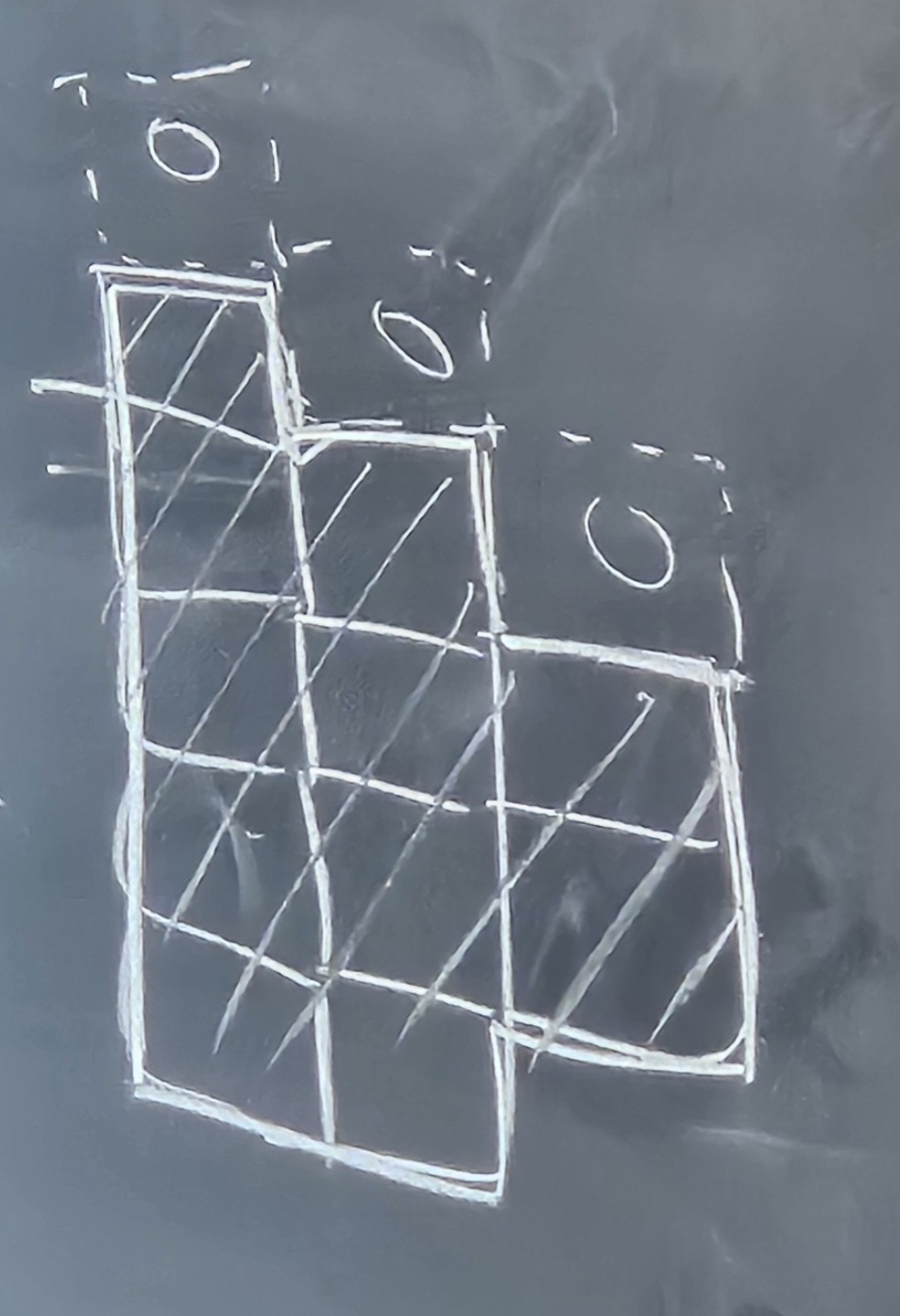
and
- For each row
- Put dots on the first of each row in both
and - Flip
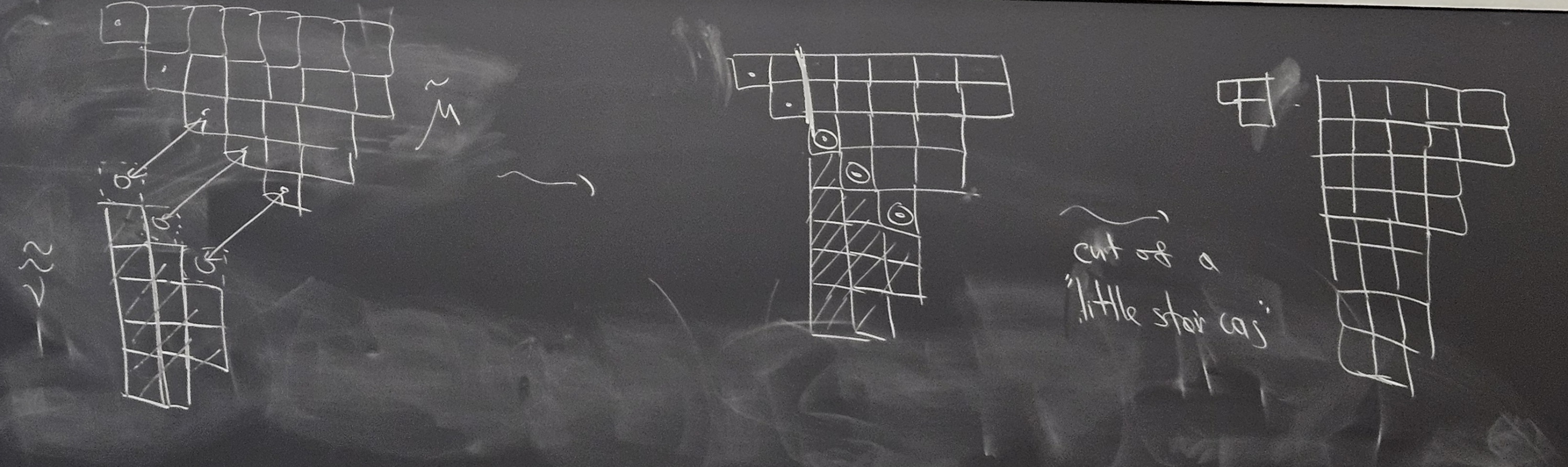
across the diagonal to produce - Glue the last
dots on the diagonal of and together. - Remove the little staircase to the left / above so that what we get at the end is a Young diagram
We letbe the resulting Young diagram and we cut out rows (if we cut on the left) or rows (if we cut on top)
In that case that
which you can interpret as the size of the construction that we got (without removing the staircase) is equal to the sum of the two sizes minus the diagonal that we cut out, which is
In the case that, we note that - we delete
rows (note we subtract one because we lose one from the gluing), so
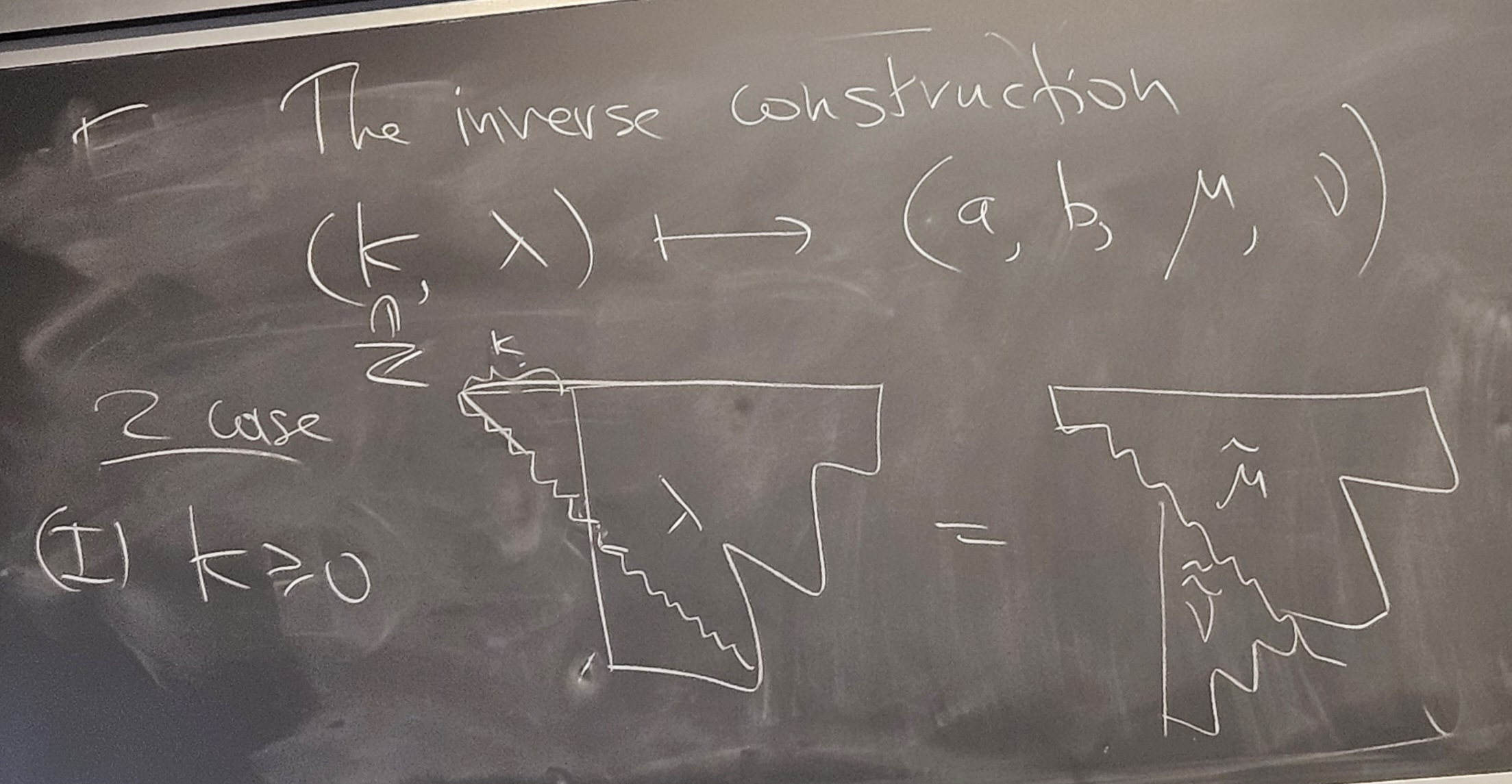
Now the inverse construction is given as follows (we are essentially reversing all the steps):
- If
, we take and attach a -staircase to the upper left. We then extend the staircase to chop into and - Otherwise, we attack a
staircase on top and do the same thing
Example of bijection:
Example 1: Let
The result of step 1 on
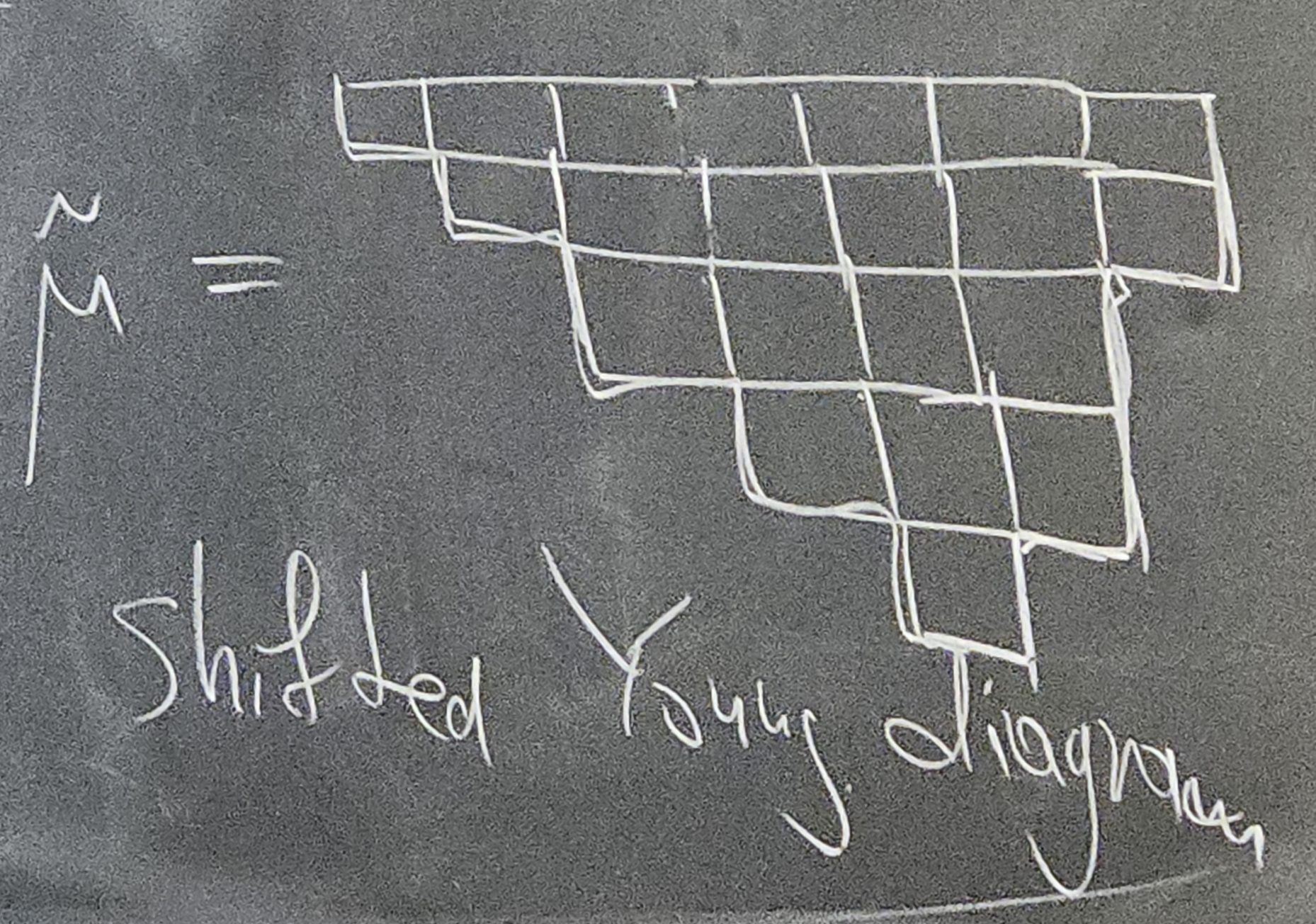
The result of steps 1-3 on
Steps 4, 5:
Example 2: Let
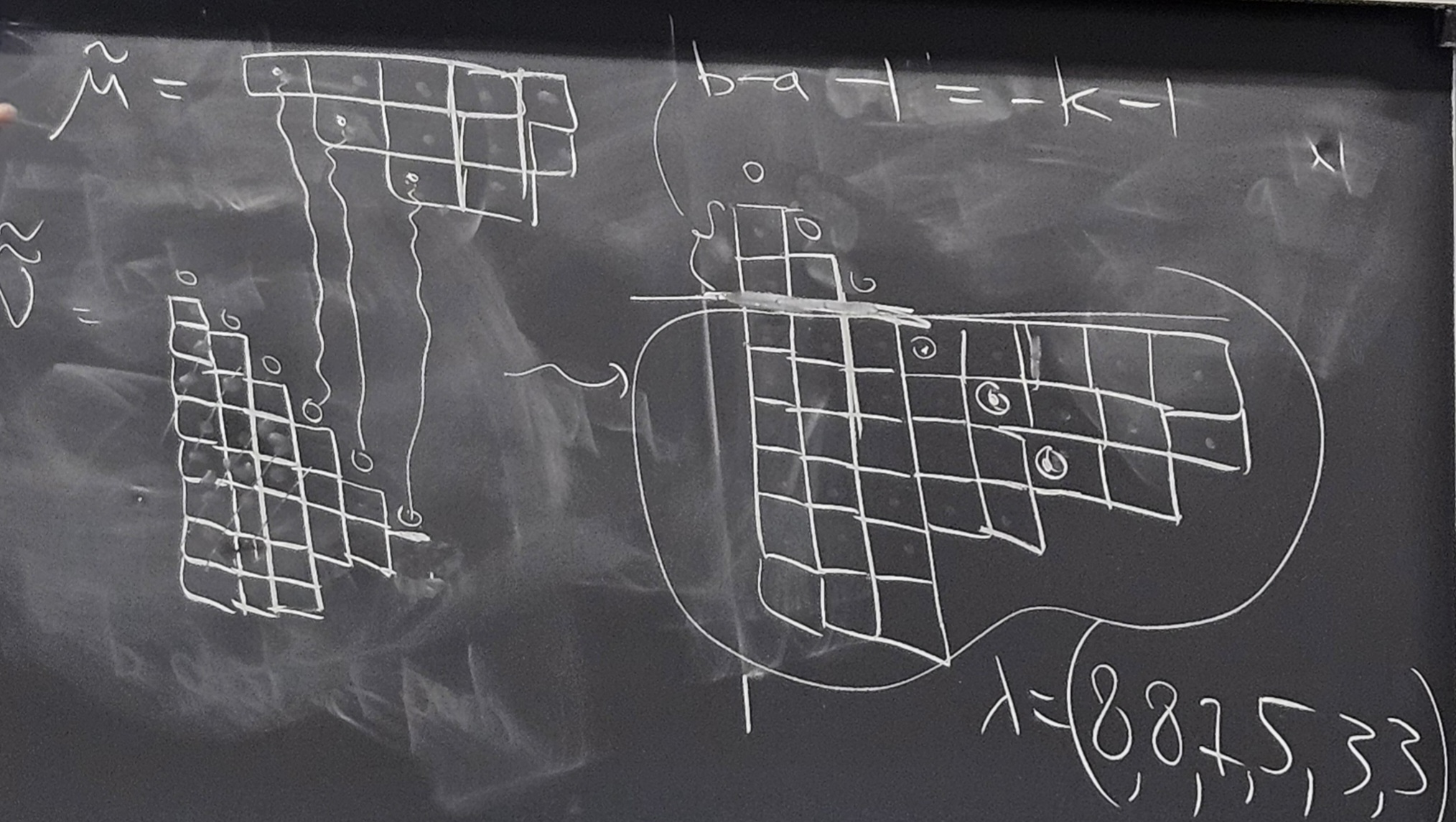
Now for the other direction of the bijection: