q-binomial coefficients are generating functions for size of bounded young diagrams
Tags: #theorem
Statement
where the left is q-binomial coefficient,
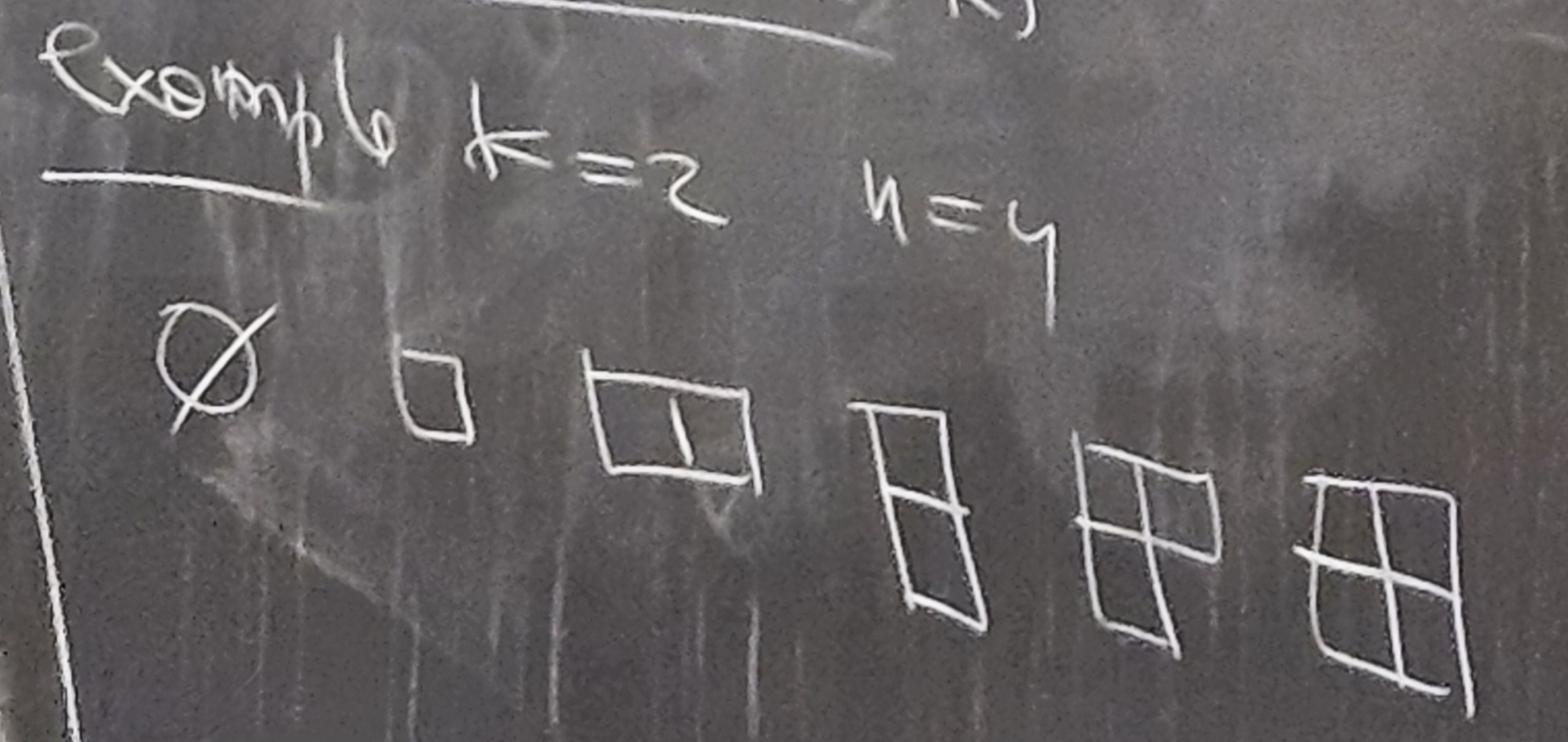
as a corollary, generating function for size of young diagrams
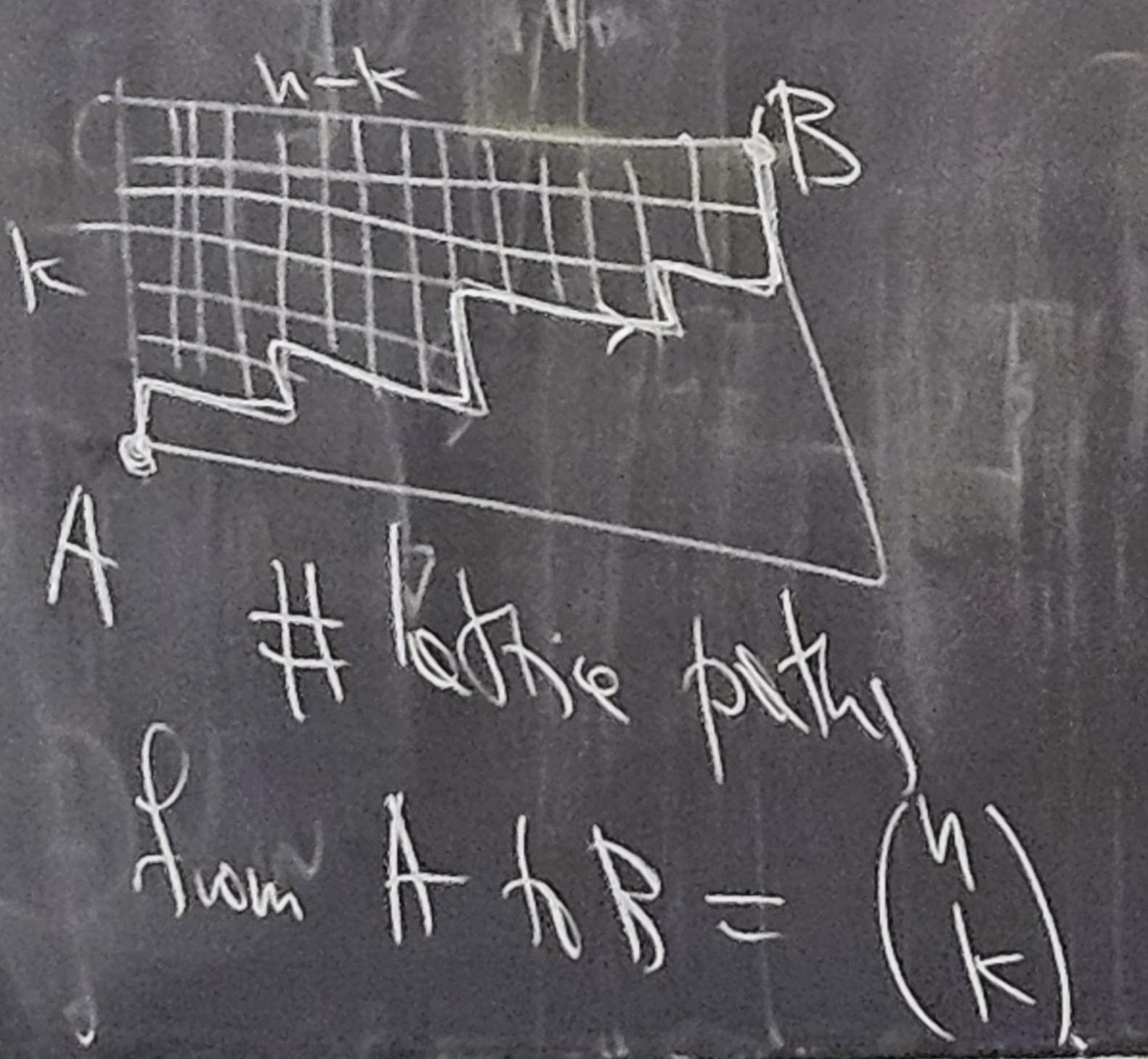
(Note these can be viewed as a lattice path from
Proof 1 (recurrence relation)
We show that the RHS satisfies the
Let
. This means the last row of the rectangle is empty. Then, . This means in particular that every row has an element, so the first row is filled. We may remove the first column and so this new permutation fits in . By doing so, we remove boxes, so we add it back by multiplying .
Proof 2 (counting number of k-dim subspaces of n-dim space over F_q)
Recall:
- if two rational functions are equal at infinitely many points, then they are equal.
- for all
, there exists a finite field of cardinality .
We shall prove this by showing that this is equal to
Let
can be anything but the zero vector, so can be anything not in the span of , so can be anything not in the span of the above two vectors, so - and so on until
So there arepossible choices for these vectors.
But different choices of vectors can yield the same rowspace, so we have to mod out by these. Rowspace is preserved under row operations, which corresponds to multiplying on the left by an invertible
Taking the quotient, we note that
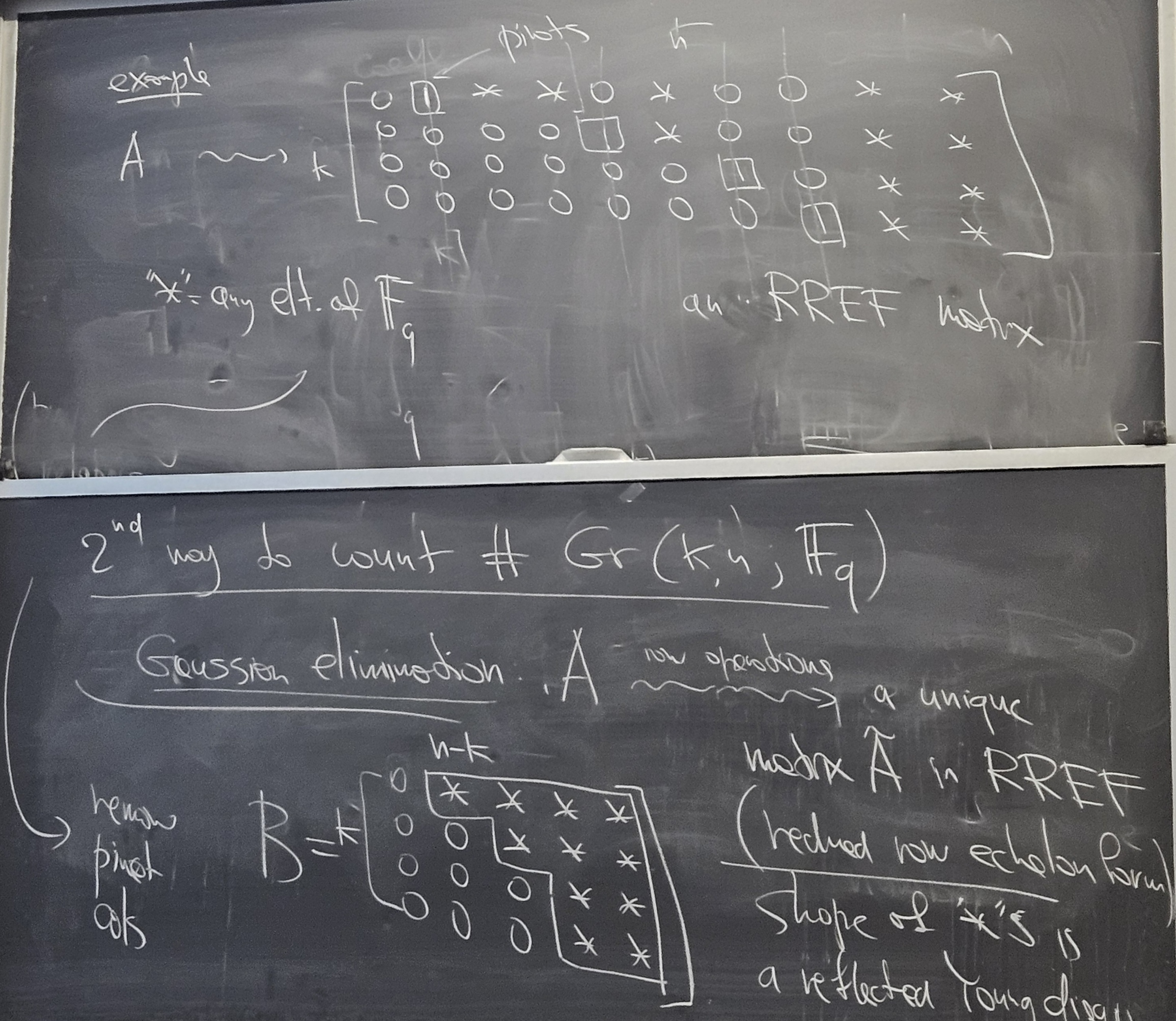
On the other hand, we can apply Gaussian elimination on
Note that in order for
On the other hand, given a Young diagram, we may right align it within a box and for each row, add a column to the left of it with 1 at the row. Then, within each box, we may fill it with any element of