sum over squares of number of SYTs is n!
Tags: #theorem
Statement
where
Proof 1 (RSK)
Robinson-Schensted-Knud (RSK) correspondence gives a bijection between all permutations of
Proof 2 (Young's lattice)
Note that
Let
by mapping by mapping
For example, (I use partition notation, but in class we drew the tableaux)
note the coefficient of which is
From this, we claim that
Key lemma:
- The second statement is true from the definitions.
- Note that the LHS of the first statement is the commutator but notably this does not say that it is commutative (the RHS would have to be zero).
- Example: Let
. Then, we note that and . Their difference is indeed . - Proof: Rephrasing this combinatorially, it is saying that if we have
a Young diagram, it satisfies the following two conditions - A) the number of ways to get from
(for ) via an up step then a down step (in Young's lattice) is equal to the number of ways to get from via a down step and then an up step - Note that if we can reach
from in this manner, we'd be able to get there by moving a box in somewhere else to get . From here, we see that this is true.
- Note that if we can reach
- B) if there are
items that are covered by , then there are items covering . - To get something covering
, we can add a box to an outer corner of its Young diagram (open dot) - To get something covered by
, we may remove a box from an inner corner of its Young diagram (filled in dot) 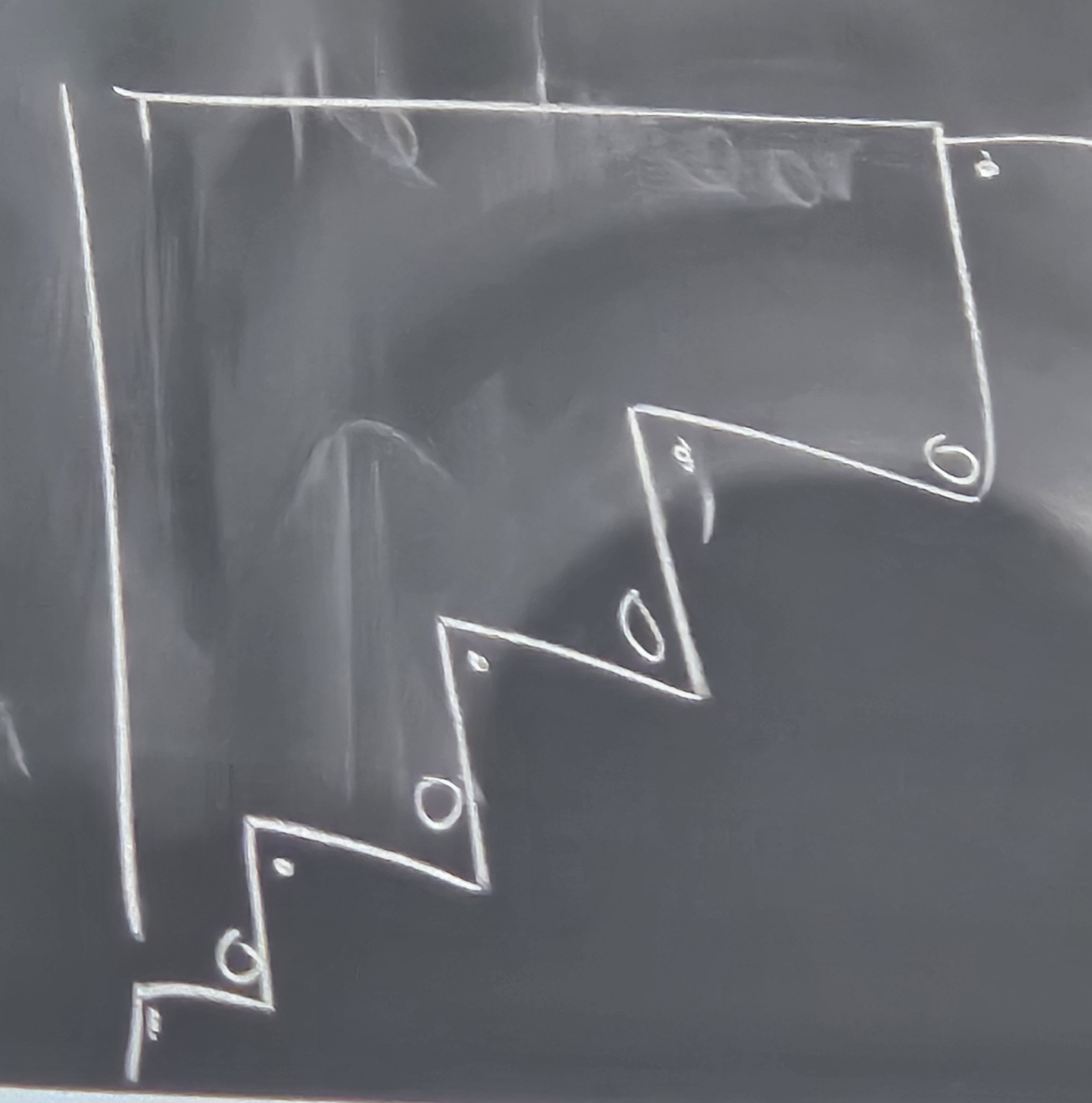
- We note that these boxes are always alternating and that there will be one more outer corner than inner corner
- To get something covering
- A) the number of ways to get from
With the key lemma, we may prove this two ways:
2a (induction)
We shall proceed via induction on
Now let us try applying this to
2b (derivatives)
Consider the two operators acting on
They satisfy the same identities as above:
So, any identities that these satisfy will hold foras well. We know that
and so we may use this to conclude.