Cayley's formula
Tags: #theorem
Statement
The number of labellings of a tree on
Proof 1: induction
We prove the more general result: define
Then, we shall prove the claim that
and then the statement follows by setting all
We shall show this via induction. One can manually verify that this is true for
note that the only terms that survive in the summation are those where the degree of
where
But we note that
which yields the result as desired after applying the induction hypothesis.
As a corollary to this proof, number of labellings on a tree with given degrees
Proof 2: Prüfer's Coding
We build a bijection between trees with codes, which are sequences
- Find the minimal leaf
of (ie. the leaf with the least number as its labelling) - Let
such that is the edge incident to - Record
(the label thereof) - Erase
- Repeat the above steps
times.
Note that for
Decoding: given a sequence
- Find the minimum element
that is not in - Let
be the first element of - Draw the edge
- Remove
from and from - Repeat the above
times - Connect the remaining 2 elements of
by an edge
By the observation above, these tow are inverse to each other.
As a corollary to this proof, number of labellings on a tree with given degrees
Example
Say we have this tree
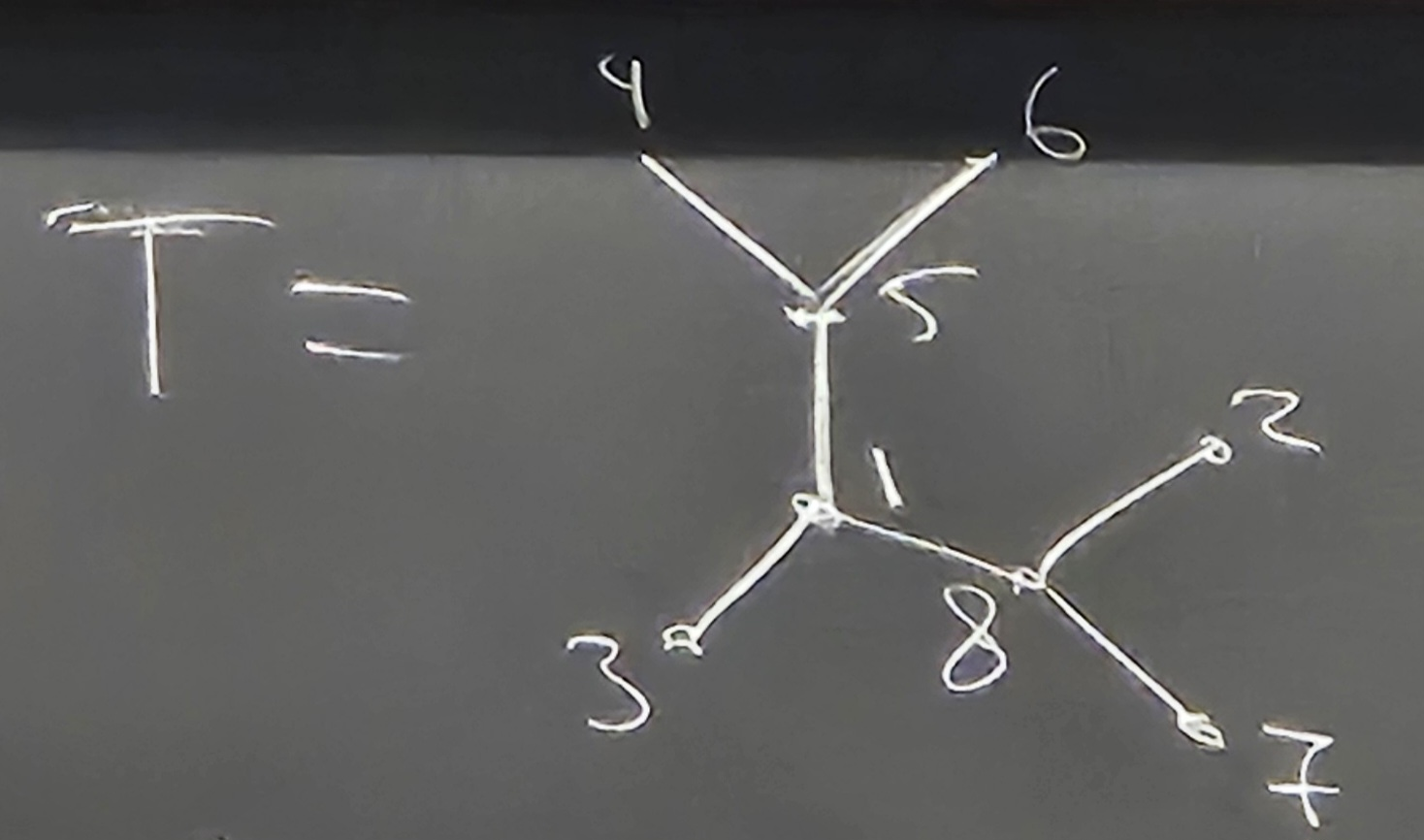
We would record:
| min leaf | 2 | 3 | 4 | 6 | 5 | 1 |
|---|---|---|---|---|---|---|
| code | 8 | 1 | 5 | 5 | 1 | 8 |
Proof 3 (Eğecioğlu-Remmel)
We shall build a bijection between labelled trees and maps
Note that there are
Given a tree
- Draw the path from 1 to
as a straight line on top, potentially with branches below - On the top row, look for right to left minima and mark those
- Cut the tree after (to the right of) each of these marked vertices
- Draw arrows to the left on the top row
- On the leftmost of each section of the top row, draw an arrow back to the last of its connected component
- For the branches below, draw them with the path to their root on the top row
- By following arrows, this gives you a function
.
Note that since the number to the left of
Given a function
- Draw a graph that corresponds to the function
- This will consist of periodic (cycles) and preperiodic points
- You can place the periodic cycles in a line at the top with the preperiodic points below them
- Arrange all cycles such that the smallest of them is on the right
- Arrange each cycle such that they are decreasing
- Erase the arrows and draw the appropriate edges to create the tree
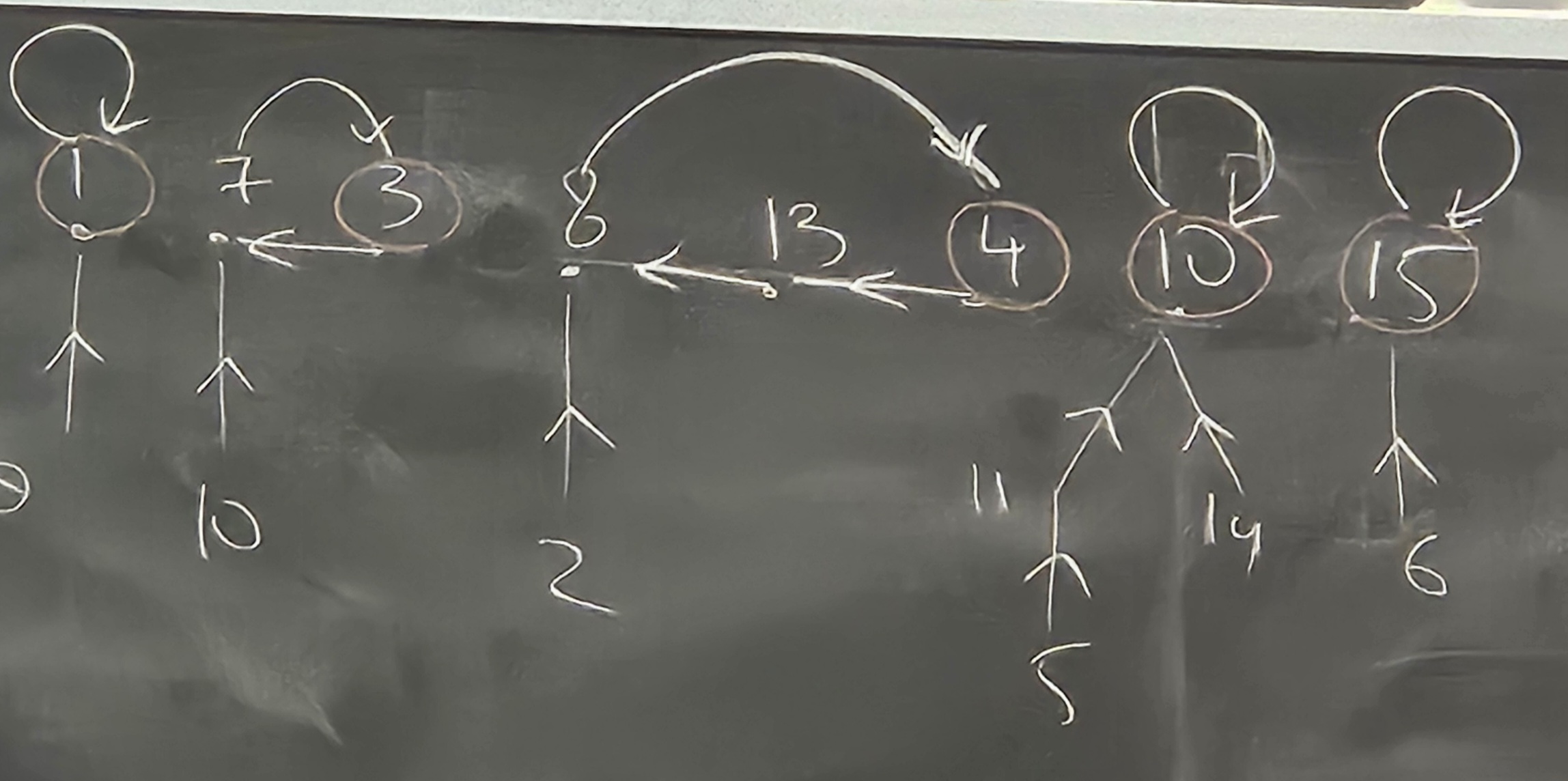
Example
The tree:
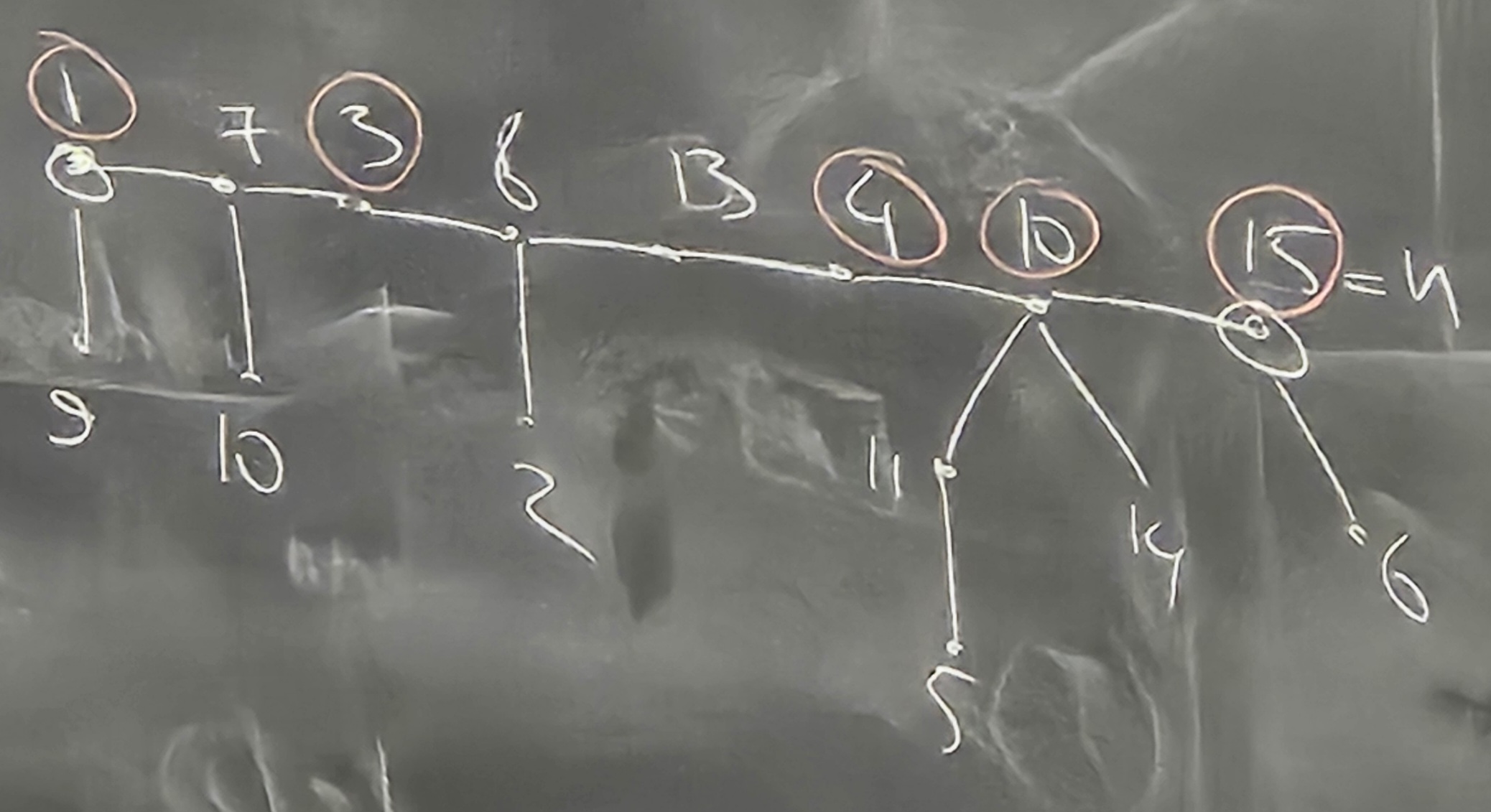
and the resulting function: