Base case: contains only edges ending at root . Then, there are no arborescences, and on the other hand, will only have nonzero entries on the th column. When we remove it, we'll have the zero matrix and get a determinant of 0.
Inductive case: For any , pick some edge where . Construct to be without the edge and to be with all edges that end at deleted. Note that
as any arborescence of must have a path from , and so must have an in-edge. It is either (then it would be an arborescence of ) or it isn't (arborescence of ).
On the other hand, since these graphs are obtained only by augmenting edges that end at , differ from only at the th column. Furthermore, the sum of the th columns of the smaller graph is that of . So, by linearity of the determinant.
To apply the inductive hypothesis, we note that always has less edges than . We are done if has less edges than . In the case where there are no other edges to (ie. ) we may pick another edge in place of and . If all vertices (except , but any edge that ends at will not contribute to an arborescence so we may effectively remove them and assume that this holds for all vertices of the graph) has indegree 1. In particular, we may assume that this graph has exactly edges, in which it falls in the following two cases:
If is not an arborescence, it has a directed cycle. There are no arborescences, and by a similar argument as in the undirected case, the determinant of the minors will be 0 (because of the cycle).
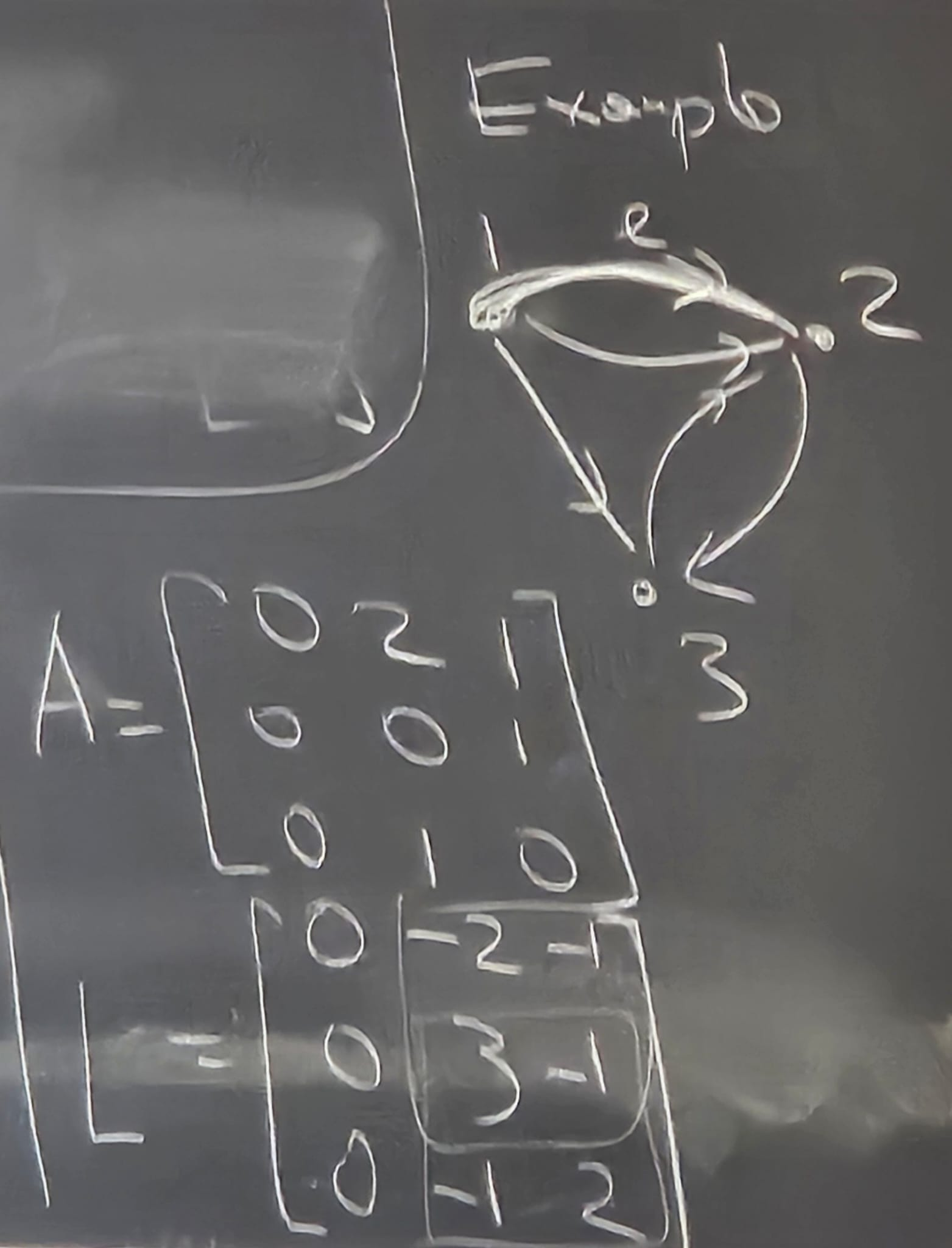
Example
Suppose we have the following graph:
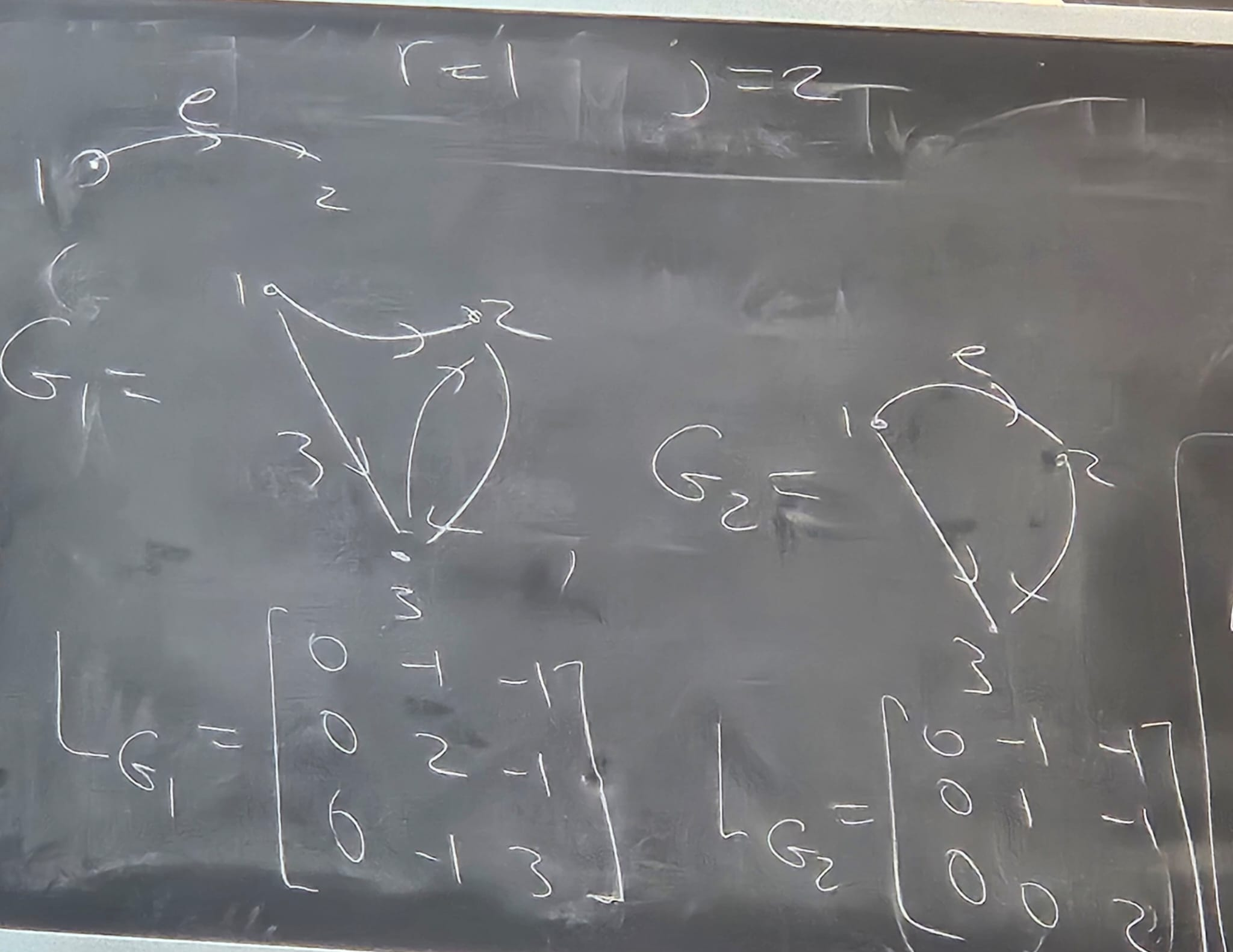
If we picked the marked edge , then our resulting graphs and would be